The short answer
An ultra long range private jet is an aircraft with intercontinental reach, listed in the Charter-A fleet guides at 4,600 to 6,150 nautical miles, flying London to Miami, Los Angeles or Dubai non-stop. Cabins have around six feet two inches of headroom and three zones, and carry 9 to 19 passengers. You need one for the longest sectors, overnight flights or the largest parties.
Key facts
- The class covers five types: Global 5000, Global 6000, Global Express XRS, Falcon 7X and the Lineage 1000.
- Range runs from 4,600 nm (Lineage 1000) to 6,150 nm (Global Express XRS).
- Passengers: 9 to 19 on the class figures, with the Lineage 1000 at up to 19.
- Cabins are 6 ft 2 in high in the Global and Falcon types, in three zones, and the Lineage 1000 is 6 ft 7 in in five.
- Heavy jets and the Praetor 600 also fly long sectors, so the ultra long range class is not always required.
What counts as an ultra long range private jet?
The name describes a class of aircraft, not a legal category. It is the group at the top of the Charter-A fleet: intercontinental range, the largest cabins in business aviation and the highest cruising altitudes. The class sits above heavy jets, which fly roughly 3,800 to 4,750 nm, and it begins where the long-haul sectors of the world open up: transatlantic flights without a stop, and flights from London to the Gulf, the American East Coast and beyond.
In the fleet guides the class is described as aircraft that fly non-stop where other aircraft need to refuel, including London to Miami, Los Angeles and Dubai. The ultra long range class page lists the types, and the table below gives the figures side by side.
| Aircraft | Passengers | Range | Cabin height | Notes from the fleet guide |
|---|---|---|---|---|
| Global 5000 | Up to 13 | 5,200 nm | 6 ft 2 in | Three zones; the Global cabin at a keener figure |
| Global 6000 | Up to 15 | 6,000 nm | 6 ft 2 in | Three zones; rear stateroom; 195 cu ft baggage |
| Global Express XRS | Up to 15 | 6,150 nm | 6 ft 2 in | Three zones; aft cabin converts to a bedroom |
| Falcon 7X | Up to 12 | 5,950 nm | 6 ft 2 in | Three engines; three-zone cabin |
| Lineage 1000 | Up to 19 | 4,600 nm | 6 ft 7 in | VIP airliner; five zones; private bedroom |
Figures from the Charter-A fleet guides; passenger numbers are the highest seen for each type. The first four cruise at 488 knots and are certified to 51,000 feet. The Lineage 1000 is certified to 41,000 feet and has no cruise speed recorded in the guides.
Which routes need an ultra long range jet?
The fleet guides name the sectors the class is built for. The Global 6000 is described for London to Miami, Dubai and the US West Coast non-stop, the Global Express XRS for London to Miami, comfortably non-stop, and the Falcon 7X for London to Miami with margin to spare. The Global 5000 is described as transatlantic non-stop.
Where range alone is the test, it is worth knowing how many other aircraft clear it. The question is not whether an ultra long range jet can do a route, but whether a cheaper aircraft can do it with a margin you are comfortable with.
| Sector type | Aircraft that can serve it | Notes |
|---|---|---|
| London to New York | Heavy jets such as the Gulfstream G350 and Falcon 900LX; the Praetor 600; the ultra long range jets | The fleet guides list London to New York for the G350, the 900LX and the Praetor 600 |
| London to Miami, Los Angeles, the US West Coast | Ultra long range jets | Named in the guides for the Global 6000, Global Express XRS and Falcon 7X |
| London to Dubai | The Falcon 900LX, the heavy class and the ultra long range jets | Listed for the Falcon 900LX and the Global 6000 |
| Middle East to the UK | The Gulfstream GIV-SP, the Hawker 4000 and above | Each is described as flying the sector in one go |
Taken from the aircraft descriptions in the Charter-A fleet guides. The aircraft offered on a given date depends on availability, passengers and bags.
Do you always need an ultra long range jet for a transatlantic flight?
No, and this is the point that saves money. The heavy class is described as linking the UK with North America, the Gulf and West Africa, and the heavy jets offer heavy-jet space at a keener price than the ultra long range fleet. Some types add a short fuel stop on the longest Atlantic sectors, and the fleet guides say so openly for the Legacy 650 and the Falcon 900B. The super midsize Praetor 600 has 4,018 nm of range and is described as crossing the Atlantic, and the Challenger 3500 as crossing from northern Europe.
So the case for an ultra long range jet is made by something other than distance alone. It is the right answer when one or more of these apply:
- The sector is long enough that you want to be certain of no fuel stop, whatever the winds.
- You want to travel overnight with beds made up and land rested.
- The party is larger than a heavy jet carries: 15 or 19 seats.
- You want the most cabin space for working, dining and meeting on a long flight.
- The route is a long-haul sector beyond the heavy class, such as the US West Coast.
If the choice is close, ask for a quote in a heavy jet and in an ultra long range jet. The article on how far a private jet can fly non-stop explains why range on paper and range on the day differ.
What do the cabins offer?
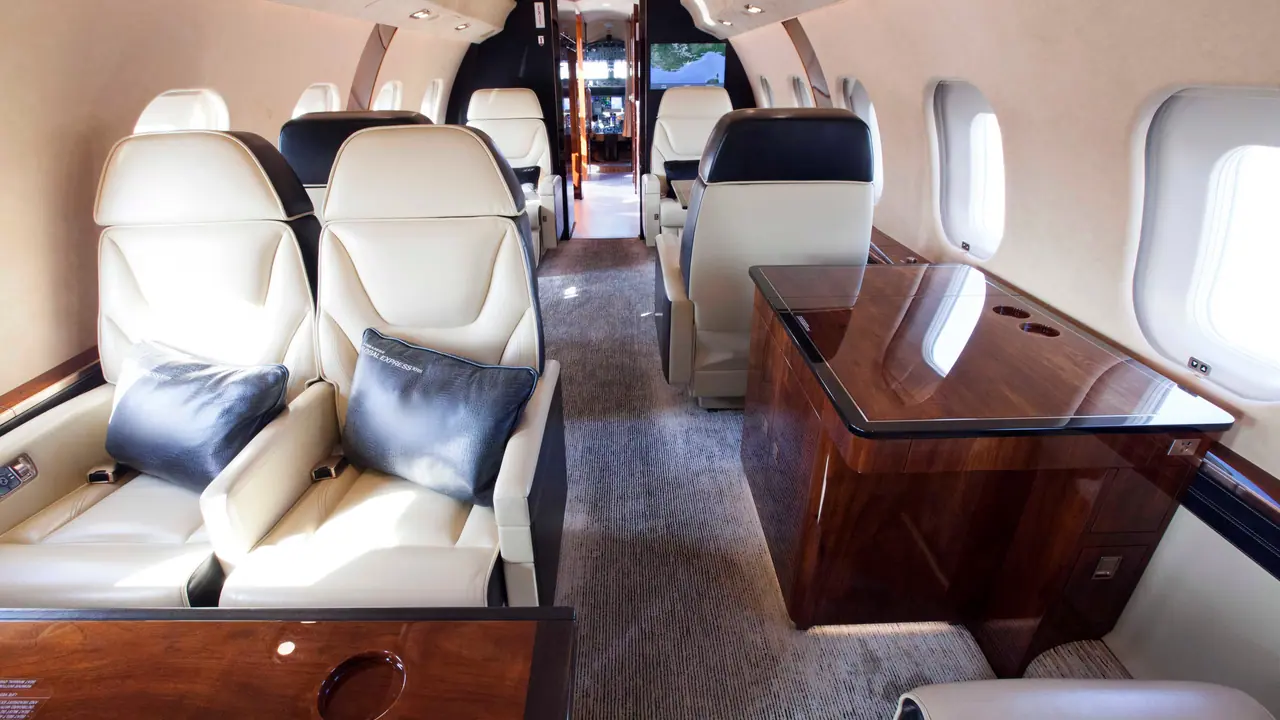
The ultra long range cabins are described as the largest in business aviation short of a converted airliner. The Global and Falcon types have around six feet two inches of headroom and three living zones, so a party has separate areas to dine, work and rest. The Global 6000 adds a rear stateroom, and on the Global Express XRS the day and night layouts convert the aft cabin into a bedroom, which is why it is described as built for the overnight Atlantic crossing.
The fleet guides also record how the aircraft are built. The Global 6000 has a supercritical wing, described as giving one of the smoothest rides in the sky. The Falcon 7X has full digital flight control and three engines, and the guide describes the three-engine layout as reassurance on long ocean crossings. The ultra long range aircraft cruise at up to 51,000 feet, above airline traffic and most weather.
What is the Lineage 1000, and why is it different?
The Lineage 1000 is a VIP airliner: an Embraer E190 airframe converted into five cabin zones for up to nineteen. The fleet guide lists lounges, a dining area, a cinema-style saloon and, at the rear, a private bedroom with a full-size bed. Headroom is 6 ft 7 in from nose to tail. It is the most cabin space available to charter short of a full airliner.
Its range, at 4,600 nm, is the lowest in the class and similar to the longest heavy jets, so it is chosen for the size of the party and the space rather than for the longest sectors. If your route is near the limit of range, say so, and we check it against the aircraft. It is also certified to 41,000 feet, against 51,000 for the Global and Falcon types.
What should you ask before you book one?
- The seat count and layout of the actual aircraft, since the figures here are the highest for the type.
- Whether the route is flown without a stop on your date, with your passengers and bags.
- Whether there is a bedroom or stateroom, and how many people it suits, if sleeping matters. The fleet guides do not give berth numbers.
- Whether a heavy jet would do the route, and what the price difference is.
- The airports at both ends, and their opening hours and customs arrangements, which are on our airport pages.
Charter-A is a broker: we find and manage the flight with an approved operator and send options with one inclusive price. Aircraft offered depend on availability on your dates, and we do not promise a specific aircraft before the quote. For how pricing works, see how much it costs to charter a private jet; guide rates for large and long-range jets start at around £6,000 to £8,000 per flying hour and go up from there.
How do the five types differ from each other?
Within one class there is a real choice, and the fleet guides give each type a character. The Global 5000 is described as the sensible route into the Global experience: transatlantic non-stop, at a keener figure than its longer-legged siblings, with twelve or thirteen passengers and room to dine, meet and sleep. The Global 6000 is described as Bombardier’s definitive ultra long range jet, with 6,000 nm of reach and a three-zone cabin.
The Global Express XRS is the long-legged flagship of its generation, with fifteen seats across three zones and the longest range in the fleet at 6,150 nm. The Falcon 7X takes a different route to the same result: three engines, full digital flight control and aerodynamics that let it use airports big jets cannot, with twelve passengers in a three-zone cabin. And the Lineage 1000 is the one for the largest parties, where the range is lower and the space is the point.
How much more does an ultra long range jet cost than a heavy jet?
The cost article gives the 2026 market ranges that Charter-A publishes, in euros per flying hour: €6,500 to €12,000 for super midsize and heavy jets together, and €12,000 to €25,000 and more for ultra long range jets and VIP airliners. They are guides, not quotations, and the aircraft available on your dates sets the real price. The point of the comparison is the shape of it: the hourly rate for the top class starts roughly where the heavy class ends.
That is why it pays to ask the right question. If a heavy jet flies the route with your party and bags, the heavy-jet price is the keener one, and the fleet guides say so directly for the Legacy 650. If it needs a fuel stop that you would rather avoid, or if you want the stateroom, the larger aircraft earns its price. Because a charter is priced for the whole aircraft and the flying time, a long sector at the top hourly rate is a considerable sum, and a quote with two options shows it plainly.
What is the difference in practice between three zones and one?
In a smaller jet the cabin is a single room with the seats facing each other in pairs. In the heavy and ultra long range aircraft the cabin is divided into zones, and the guides describe what they hold: club seating, a dining group, and a place to rest with a sofa, divan or bed. The Global 6000 is described with three cabin zones and a rear stateroom, and the Lineage 1000 with five.
On a flight of eight or ten hours that is the difference between sitting in one place and having somewhere to go. It is also why the ultra long range class is chosen for overnight sectors: you board, dine, sleep in a made-up bed and land rested, as the guide describes it for the Global Express XRS. For a shorter day flight across the Atlantic, the zones matter less, and the heavy class often does the job.
Are there smaller options if you only need long range some of the time?
Yes, and it is a common way to spend less. If your usual travel is within Europe and the occasional long flight is the exception, there is no reason to charter an ultra long range aircraft for the European legs. Charter-A is a broker, not an operator with a fixed fleet, so each flight is matched to the aircraft that suits it: a light or midsize jet for the short sectors and a heavy or ultra long range jet for the long one.
That is also why there is no minimum spend or membership. You choose the aircraft for each trip, with options priced side by side, and the longest-range types appear on the quote only when the route or the party calls for them. The fleet pages show every type, and the ultra long range class page lists the five covered here.
More questions
What is the difference between a heavy jet and an ultra long range jet?
Range and cabin. Heavy jets in the fleet guides fly about 3,800 to 4,750 nautical miles; ultra long range jets 4,600 to 6,150. The ultra long range cabins are also larger, with three zones, around 6 ft 2 in of headroom and, on some types, a stateroom or bedroom.
Which private jets can fly London to Miami non-stop?
The Global 6000, Global Express XRS and Falcon 7X are all described for London to Miami non-stop. Range on the day depends on passengers, bags and winds, and we confirm it for your flight when the operator prices it.
How many passengers can an ultra long range jet carry?
The class figures are 9 to 19. The Global 5000 carries up to 13, the Global 6000 and Global Express XRS up to 15, the Falcon 7X up to 12 and the Lineage 1000 up to 19. These are the highest seen for each type.
Can you sleep on an ultra long range jet?
Some are set up for it. The Global 6000 has a rear stateroom, the Global Express XRS converts its aft cabin into a bedroom and the Lineage 1000 has a private bedroom with a full-size bed. Ask which layout the aircraft offered for your trip has.
Is an ultra long range jet needed for a flight to New York?
Not always. The fleet guides describe the Gulfstream G350, the Falcon 900LX and the Praetor 600 as flying London to New York, so a heavy or super midsize jet can serve it. The ultra long range class offers more margin and more space.
How much does an ultra long range jet cost?
Charter-A publishes 2026 guide rates of roughly €12,000 to €25,000 and more per flying hour for ultra long range jets and VIP airliners. The price of your trip depends on the aircraft, the route and the dates, so it is quoted individually.
Related articles
Which size of private jet do I need?
Compared by size, the rule is simple: choose the smallest aircraft that carries your party and its luggage the distance without stopping.
How much does it cost to charter a private jet?
Chartering a private jet typically costs from around £2,000 to £3,000 per flying hour for a small jet, rising to £6,000 to £8,000 per hour and more for a large or long-range jet.
How far can a private jet fly without stopping?
A private jet can fly from about 1,150 nautical miles in the smallest very light jet to 6,150 nautical miles in the longest-range aircraft in the fleet guides.
On this site
More from Charter-A.com
Aircraft figures, cabin features and sector descriptions are from the Charter-A fleet guides in data/fleet.js; guide rates are the 2026 ranges in Charter-A’s cost guide, as stated in the existing cost article. Charter-A Ltd acts as agent for the passenger; details are confirmed for each flight at booking.